
 |
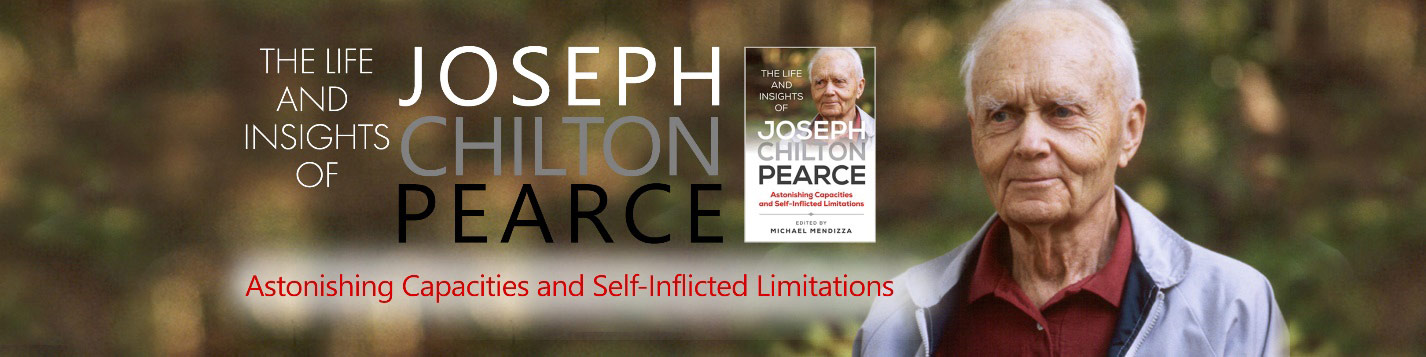
Joseph Chilton Pearce: A Brief Overview of Bonding
and the Clash of Biological and Cultural Imperatives
A Conflict between Nature’s Intelligence and Human Intellect
Paul MacLean, for many decades head of the Department of Brain Evolution
and Behavior at the National Institutes of Health, wrote a paper
on three fundamental needs critical to all mammalian life, particularly
human, from the moment of birth. These three needs (each calling
for voluminous description) can be stated, in their barest terms,
as Audio-visual communication, Nurturing, and Play. All three are
interdependent; all are established and stabilized by mother-infant
bonding at birth. Deprived of bonding, all subsequent development
(of both infant and mother) is compromised.
Years ago Muriel Beadle asked why is it that the human infant seems
born into the world in a state of alert excitement that quickly
reverts to distress followed by conscious withdrawal. (This withdrawal
lasts for ten to twelve weeks on average.) Answering Beadle’s
query leads to a richly woven fabric of nature‘s proposing
and man’s disposing.
First, all mammals, on preparing to give birth, seek out the most
hidden, preferably dark, quiet and safe haven available. At the
first sign of any intrusion, of any sort - even the snapping of
a twig - and the natural intelligence of the old mammalian brain,
which controls birthing, signals that birthing procedures stop,
and the mother wait for the coast to clear. We humans are mammals
and our old mammalian brain’s instincts and intelligences
are still right here in our head, and absolutely in charge of birthing,
interpreting environmental signals, giving and initiating intelligent
responses. In situations of complete safety, unquestioned support
and security, fully in touch with herself and nature, a human mother
can give birth in as little as twenty minutes - sum total of time
from first signal to birth-passage accomplished. But at the first
sign of any interference of any sort, regardless of the nature or
reason for it, the birthing process will be disrupted, slowed down,
or even halted, by very ancient and powerful intelligences within.
If disruption does occur, the smooth muscular coordination of resonant
responses found in a mother “in the flow,” where thinking,
feeling and acting are a single harmonious response, is lost, and
chaos generally reigns within her - muscle fighting with muscle,
instinct with instinct, inner-knowing confused by well-wishing helpers,
nature’s intentions clashing with culture’s attentions,
mother and infant losing on all fronts - all of which is sadly the
norm for the majority of modern women, and a primary cause of an
ever increasing world-wide upheaval.
Nikos Tinbergen (Nobel laureate in ethology) studied the metabolism
of the early infant and determined that a human newborn needs to
feed about every twenty minutes in its early days, the periods slowly
growing progressively longer as the months go by. Mother’s
milk, it seems, has almost no fats and proteins, but is, instead,
as Israeli doctors termed it, a rich cocktail of hormones, which
rather thin-appearing diet requires that the infant feed quite frequently
- which is the whole point. Some mammals, rabbits for instance,
produce a milk so heavy with fats and proteins their offspring need
only feed once or twice a day. This allows mother to forage to make
more rich milk for that next powerful wallop. One might wonder why
nature didn’t make a similarly handy arrangement for us humans;
instead of a procedure so inconvenient, particularly to us modern
people. Look a bit further, however, and we find that she did this
on behalf of an intricately interwoven fabric of interdependent
needs rather exclusively human and absolutely critical to being
fully human.
First, the human newborn is unique in the mammalian world in that
it produces no hydrochloric acid in its stomach. Hydrochloric acid
is necessary for the digestion of fats and proteins, found abundantly
in all mammal’s milk except that of human mothers. Some nine
months after birth, however, hydrochloric acid spontaneously appears.
Remember this nine-month marker in the exploration that follows
here.
Just as it took nature nine months to grow that infant in mother’s
womb in the first place, it takes another nine months “in
arms” to firmly establish that infant in the matrix of its
new world. In regard to MacLean’s Triad, consider that hearing
develops very early in utero, and language learning itself begins
late in the second trimester as ongoing muscular responses the infant
makes to phonemes, those foundational units of language - (if the
infant has normal hearing and a speaking mother.) Vision, however,
while it occupies more of our brain than all other senses put together,
obviously can’t develop in utero, even though visual sensitivity
appears early on, as seen in an infant’s aversion to bright
lights should we shine them directly on the mother’s belly,
(which prompts the infant to turn its head away.) Visual development,
though, and the audio-visual communication that accompanies it,
must await birth to unfold. (There is a vast difference between
stimuli and communication).
And at birth, if given a face within six to twelve inches away,
two immediate responses take place in the newborn: its initial excited
alertness (noted by Muriel Beadle long ago) stabilizes, and visual
- and audio-visual - development begins. That close-up face literally
turns on the infant brain and keeps it turned on, for the infant
is born with a preset neural pattern for cognizing-perceiving a
face, but only a face. That new visual system doesn’t respond
to other visual objects, while the infant will lock eyes on a face,
if one is given at that required distance, and hold that focus.
Then perception-cognition automatically takes place, which, in turn,
activates the infant’s entire body-brain system. Focus is
immediate so long as a face is there to focus on; parallax (muscle
coordination of the eyes) forms within minutes, (so the infant can
even follow that face around should it move about) and a “construction
of knowledge” of a visual world begins - a world based on
this stable foundation of a face.
Before long other objects in the mother’s immediate vicinity
are registered, and, through processes of neural association, corresponding
new neural patterns form, and a cognitive field of re-cognizable
objects grows exponentially (as does the brain itself) - so long
as that face-pattern remains the stable point of reference. Although
any face will work at birth (even a false face for a brief time),
face constancy and all that goes with it, is the critical factor
in this early infant movement from known to unknown, and vitally
necessary for a stable and stress free development.
Should a face not be presented, along with all the attendant functions
accompanying it (to be described shortly), conscious awareness will
fade within about 45 minutes, and does not ordinarily reappear,
as mentioned above, for upwards of some ten to twelve weeks on average.
The reason is that bonding as a reciprocal function between mother
and infant is then fragmented, and the ongoing nurturing instincts
which bonding awakens and locks into the mother’s responses
aren‘t there. Most infants then receive only sporadic exposures
to a face or faces and. by then, consciousness largely retreated,
the awareness needed for such cognition to take place and be stabilized
is missing. Nature will compensate as best she can, but under these
conditions, her capacity to compensate is diminished and slow.
Nature arranged that this magical face-trigger be some six to twelve
inches from those equally wonderful mammary glands from which flow
that life-giving fat-and-protein free nurturing-nourishment. Frequent
nursing assures a frequent reinforcing of the stable face pattern
on which vision and awareness is based. “Object constancy,”
as Piaget called it, the stabilization of an object-world of vision,
occurs around the ninth month of this busy construction period.
Among the many facets of this ninth-month milestone, myelination
of the neural patterns of this primary visual world takes place,
making the neural foundations permanent and “cheap to operate,”
the ongoing expansion of the visual world automatic and effortless.
Now nature can turn her world-building energy to other developments,
which open around that pivotal ninth month.
(Any society separating mothers from infants at birth will have
a disproportionately large population with impaired vision. The
United States, for instance, is virtually a nation of eyeglasses.
(We ignore and/or forget research that shows that preliterate people
have far more accurate and extensive vision than we have - some
of those people can see the rings of Saturn with their naked eye.)
Far more seriously, for those willing to look, note how many of
the infant-toddlers we see, pushed about in various wheeled devices
that keep them separate, out of the way and helpless, have strangely
vacant, barely focused eyes, and vapid, nobody-at-home expressions
- as though a light were blown out in their brain.)
Some forty years ago Whittlestone, at The University of Adelaide,
pointed out that the mother’s heart is a most critical factor
from conception through birth. Now we know that her heart is every
bit as critical a part of the next nine-months “in-arms.”
Over half-century ago researchers had found that a heart cell could
be removed from a live rodent’s heart, put in an appropriate
nutrient to keep it alive, and, when examined through a microscope,
would continue to pulsate, expanding and contracting regularly,
according to the rhythm set by the donor-heart. After some time
of this separation from the heart, however, that rhythmic pulsation
would deteriorate until collapse, and that erratic jerky spasm called
fibrillation, precursor to death of the cell, would set in. If two
heart cells were placed on the slide, however, separated from each
other, when fibrillation began, through bringing the two cells into
close proximity with each other (they did not have to touch and
could be separated by a tiny barrier) they both stopped their death-spasms
and reestablished their coordinated pulsation, in sync with each
other. Each cell had “lifted the other” out of that
fibrillation that leads to death into the shared rhythm of life.
This miracle occurs, it turns out, through bringing into spatial
conjunction the electro-magnetic fields that arise from and surround
each heart cell, a phenomenon only recently discovered. These electro-magnetic
(EM) fields are not affected by ordinary physical boundaries, and
when the fields come into contact, their waves entrain, go into
the same coherent pattern, (and coherent wave-forms reinforce each
other.) This coherent resonance, in turn, lifts those cells out
of chaos into order. Cells and their “EM” fields mutually
give rise to and/or influence each other, and the same phenomenon
occurs, on a far larger and far more serious level, with infant-mother
hearts at birth, a major but largely unrecognized factor in bonding.
The heart itself produces a very powerful “EM” field,
in three successive waves: the first and most powerful surrounds
the persons’ body flooding every cell and neuron of that body;
the second extends out some three feet in all directions and interacts
with other heart fields within that proximity, a principle ingredient
of emotion and interpersonal relationships; the third extends out
indefinitely, for all purposes “universally,” (possibly
a factor or aspect of the human spirit.)
So at birth, following separation, infant and mother’s heart
must be brought into immediate proximity, wherein they confirm and
stabilize each other or “lift each other” into their
familiar, stabilized order. This order must be continually reinforced
through that warm proximity for about a nine-month period. By that
time the infant heart has matured enough to “stand on its
own” without so frequent a stabilization by mother’s
heart. Thus here we have another ninth-month milestone marker.
Before leaving this issue, consider the fact that sperm and egg
can be introduced in a test-tube, (deadly dull affair) which may,
(with sufficient sperm in support?) result in their union. This
shotgun coupling is followed by two or three cellular divisions
of that egg, as triggered by genetic coding, but no more. Cell division
will not continue after those first few gestures toward life, regardless
of type of vitro, temperature at which the fluid is kept and so
on (variations of which have been tried over the years.) Thus no
actual “test-tube” baby has ever taken place and never
will. The term is itself a myth-making misnomer (reinforcing the
mechanization-myth science has woven around genetics and medicine
around conception and gestation), since, following that test-tube
insemination, the DNA of that newly formed genetic system must be
placed within the immediate electro-magnetic radiations of a mother’s
heart. These are found, conveniently, in her womb, where by odd
coincidence, in addition to the rich sea of EM energy with which
mother’s heart floods that area, nature provides an equally
rich sea of nutrients and just the right temperature for ongoing
cell division to take place.
DNA is not only both environmentally and electro-magnetically sensitive
and responsive, it is critically dependent on these signals for
the unfolding of nature‘s blueprint for new life. Without
the appropriate nurturing environment of womb and heart, gestation
can’t take place. So, once cell division begins, that dividing
cell must be planted in a mother’s womb or frozen for some
hypothetical future planting, and quickly.
So at birth, an immediate return to the mother’s heart-field
must be given, or severe infant distress sets in, followed by eventual
withdrawal of awareness and alertness. (Forty-five minutes seems
about the average “window” of opportunity for establishing
the infant-mother relation needed, a relation centered on that heart-field
link.) Again, that six-to-twelve inch distance of the mother’s
face, giving immediate proximity to those nurturing breasts, vital
to the ongoing awakening experience of the newborn, assures a return
to and ongoing stabilization of the infant’s heart given by
the mother’s heart, to which resonance the infant has imprinted
on a cellular level from conception. Newborns and mothers wired
up for heart and brain wave recordings (electrocardiograms and electroencephalograms)
show coherency and entrainment (matching of the wave frequencies)
when infant and mother are together. Both systems become incoherent
(chaotic) if prolonged separation takes place, whereupon cortisol
is released by both mother and child systems and general stress
takes place. Remember our two heart cells on that microscope‘s
slide, and remember that excess cortisol is quite toxic to neural
systems, particularly new ones.
(Remember also that any society interfering with natural bonding
at birth will have a corresponding increase of heart trouble. When
primary heart connections fail to take place, heart development
in the infant is immediately compromised, and a “wounded heart“
trauma takes place in the mother, whether she is aware of it or
not. The “Post-partum blues” that often follows birth-separation
can be a devastating experience, affecting the health of both parties
thereafter.)
Years ago biologist-anthropologist Ashley Montague wrote a now-classic
work called Touching, and recently Mariana Caplan wrote a similar
work called Untouched. Both are well documented studies showing
the critical necessity of infant skin-stimulus at birth. For at
birth, the newborn’s nervous system is quite undeveloped since
the millions of sensory nerve endings distributed over the body
can’t be activated or developed in utero. In that water world
the infant’s body is protected by a “water-proof”
coating of a fatty substance called vernix caseous, which protection
also insulates that myriad of nerve endings. So at birth all mammalian
mothers vigorously lick their infants off and on for many hours,
even sporadically for days thereafter. This is to activate the dormant
sensory nerve endings and the peripheral nervous system, which is,
of course, a primary extension of the brain. Failure to activate
these nerve endings results in a de-sensitization affecting the
reticular activating system of the old brain, where all sensory
stimuli is collated or organized into those resonant patterns which
are then sent on to higher cortical areas of the brain for world-making
and experiencing. Touch deprivation results in a compromised and
diminished over-all neural growth, sensory system and general conscious
awareness in the infant, as well as affecting inner ear development,
balance, spatial patterning and so on, later.
(Mothers separated from their infants at birth obviously can’t
provide this touch-stimulus, nor are they stimulated to do so later
if the separation is prolonged. Mother, too has a critical “window
of opportunity” for activating those ancient nurturing responses,
considered by Paul MacLean to be our “species survival instincts.”
These instincts are activated by her skin to skin contact with her
infant, making bonding a reciprocal dynamic of awaking and discovery.
)
Language learning, which, as mentioned, begins late in the second
trimester as muscular responses the infant makes to the phonetic
content of the mother’s speech. This dynamic continues after
birth, if the appropriate model-stimulus is provided - a speaking
mother in close proximity. The newborn then remains open to phonetic
systems in general and will respond to new phonemes with corresponding
new muscular patterns, until some nine months after birth, at which
time the basic phonetic-muscular system myelinates, becomes permanent,
and phonetic openness closes to the boundaries of the mother‘s
speech.
During that initial nine-months of continued language learning and
phonetic completion, speech preparation takes place. Speech is a
dramatically different neural-muscular operation than the earlier
body-language dynamic, yet subject to the same model-imperative.
From the moment of birth, given that face pattern to organize vision
around, the infant responds to the mother’s facial and neck
muscle movements made when she speaks, by making corresponding muscular
movements in synchrony with hers, though in a less “robust”
manner. (There is, for example, the well-known and certainly robust
response of the infant sticking out its tongue if the caretaker
sticks out hers.) These mimetic responses, which mirror facial and
neck muscular movements of mother’s speech, automatically
connect the infant’s audio and visual worlds, through pairing
her word usage with the overall phonetic-muscular patterns of his
body. Thus this primary audio-visual communication prepares for
speech (which involves coordinating over 200 fine-tuned and some
very delicate facial-neck muscles.) Around the ninth month after
birth the average infant’s speech preparations have led into
“lalling” or infant-babbling and even the first words
- if, and only if, of course, the appropriate model-signal-stimuli
are provided in that critical second-matrix period, a provision
made by simply nursing the infant and speaking.
(Infants separated from their mothers and confined to various forms
of ongoing separation thereafter (as most modern infants are - through
cribs, bassinets, carriages, playpens, strollers, etc., or that
most immediate and thorough devastation called day-care), are denied
all these responses, and their development is correspondingly compromised.
Nature will compensate as best she can - but compensation is always
a poor substitute for natural, spontaneous mimetic growth. We live
in a compensated society, however, where the abnormal has been sustained
until it has become the norm - we citizen-victims none the wiser.)
Finally (in this brief survey), but perhaps the most important of
all these ninth-month-markers, we come to the prefrontal cortex,
a major neural system, which cannot unfold in utero (except in a
most rudimentary form) and must await birth to begin its full cellular
growth. If conditions are right, it will develop into the largest
neural lobe. During the in-arms and early crawling period, the primary
phase of prefrontal growth takes place, completing in that significant
ninth month. (A second growth spurt, equally “experience dependent,”
is designed to begin at mid-adolescence. This later prefrontal growth-spurt
is critically dependent on the successful completion of the first
one.)
Since the mid 1980’s the prefrontal cortex been the subject
of intense investigation but already is recognized as the latest
evolutionary neural system to develop, (it is probably less than
50,000 years old, compared to millions up to hundreds of millions
of years behind the older lobes and modules of our brain.) This
latest and greatest of nature’s neural achievement proves
to be the “executive brain,” able to moderate and control
all responses, reactions, and instincts of those older “animal
brains,” with their sensory-motor, defensive, sexual and instinct-bound
patterns, as well as the “neo-cortex“ giving us speech
and a vastly higher intellect. Only this newest prefrontal system
can organize the entire brain into a smoothly synchronous attention
or intention, link all our “lower instincts,” as well
as thinking-feeling, with higher fields of intelligence, and translate
all the “higher human attributes“ such as love, empathy,
care, and creativity, into daily action. The prefrontal cortex gives
us what Elkhonon Goldberg rightly calls “civilized mind.”
If developed.
But, as Allan Schore’s research makes clear, the genetic structure
of the prefrontal cortex proves to be the most “experience-dependent“
of all brain systems, that is, those genetic systems are critically
dependent on appropriate environmental feedback. This feedback is
given through the multi-leveled functions of infant-mother bonding
and ongoing relations, and the overall positive emotional environment
that should result. This feedback includes nurturing through breastfeeding,
sufficient movement and sensory stimuli, immediate proximity to
the mother’s face and heart, the continual coherent resonance
between mother and infant heart fields, language and speech stimuli,
and so on. Failure to provide this overall emotional support inevitably
means a compromised prefrontal cortex. It literally cannot grow
sufficient cellular structures and make the necessary neural connections
with the rest of the brain for full operation. And a compromised
prefrontal cortex results in an impaired “emotional intelligence,”
with a corresponding difficulty in relating with others or controlling
our ancient sexual-survival reflexes, with a corresponding tendency
toward apathy, hopelessness, despair, and/or any of the many forms
of violence.
Just as it took nature nine months to grow the basic “triune
brain” unfolding in utero, this prefrontal growth takes the
nine months following birth, with all the attendant developments
which center around the heart. Thus all these strands, briefly sketched
in the above, gather to completion around this ninth month milestone.
Then, if the necessary foundations are in place and functional,
from the ninth to twelfth month another major neural structure grows
to connect this new evolutionary “executive brain” with
the ancient limbic or emotional brain, which older system has direct
unmediated neural connections with the heart (through the ancient
amygdala which is as much the top part of the defensive “hind-brain“
as lowest part of the emotional brain.) Thus this “orbito-frontal
loop” as its called, a huge bridge between old and new, proves,
as the research of Allen Schore clearly shows, the most decisive
factor of our life and is, again, critically experience dependent.
If emotional nurturing is lacking, this bridge will be compromised
and/or largely de-constructed in the little development made.
At this ninth-month point, when the orbito-frontal loop begins its
massive growth, the ancient cerebellum, in the back of the brain,
undergoes a corresponding growth spurt. The cerebellum, rudimentary
until this time since only sparsely employed, is involved in all
speech, walking, coordination of muscular systems and much more.
(This muscle coordination takes place through the muscle spindle
system, tiny neural extensions found on each striation of muscle
tissue throughout the body. These spindles played a major role in
the uterine infant’s physical response to those phonemes underlying
language, literally “embedding” language in the body.)
So, at this ninth-month period, as nature prepares to organize the
entire forebrain into a single coherent whole, the cerebellum readies
the infant body for that upright stance we humans enjoy, which will
be followed by walking and talking, displayed in that magnificent
and excited exploration of and “building structures of knowledge
of” our physical world. Infancy comes to an end and the early
child or toddler appears.
To prepare for the toddler’s excited charging out to explore
all aspects of the world, (equally dictated and orchestrated by
nature‘s agenda,) the child will not only touch but taste
every item of interest in that world, and to prepare for the new
diet-world opening, which will no doubt contain fats and proteins,
the appropriate digestive juices are forthwith provided. Nature
dutifully turns on that long-absent hydrochloric acid in the child’s
metabolic system. Hydrochoric acid simply wasn’t needed -
at least not according to millions of years of genetic encoding
- in that critical “In Arms” period, for which nature
provides a vastly superior food and supreme method of dispensing.
So we have now come full circle in this brief sketch of birth and
bonding, its ways and means and why’s, from the initial enigma
of no hydrochloric acid to its grand entrance as cued by nature,
when the curtain rises on a new stage of development, ushering in
an ongoing series of new bondings with new matrices, over the years
- the family, the earth itself, society, the pair bonding leading
to species renewal, bonding with one’s own offspring, with
the spirit within and universal without, and so on. Marshal Klaus
spoke of an interlocking “cascade of redundant patterns”
nature has built in to assure this critical first bonding between
mother and infant, which meets the threefold need MacLean referred
to, truly an “eternal golden braid” (to steal Hostadter’s
phrase). Marshal Klaus calls bonding the establishment of the greatest
love affair in the universe, on which this wondrous unfolding of
human life depends.
Now we can see the astonishing and thorough intelligence and careful
planning, the intricate interweaving of a myriad of critically timed
and interdependent responses which nature evolved over eons of time
and invested in this birth-bonding process entrusted to us. And
now, more than ever, we can see the astonishing extent to which
modern practices have by-passed, compromised, or outright eliminated,
virtually every item on the agenda of this incredible architectural
design. Now we can understand why our medical interferences with
birth - taken as axiomatic and unconsciously accepted as the norm
by virtually the entire globe - is proving to be our global undoing.
You cannot do to a living organism what we are now doing to the
vast majority of human infants, (and the ongoing spillover into
the general abandonment and neglect of children taking place world-wide,)
without paying a dreadful price. The ruinous and hugely expensive
take-over of all birthing by hospital-medical procedures has brought
into play an equally huge and expensive cradle-to-grave therapeutic
operation, undertaken in our efforts to repair the damage we are
blindly causing at the same time. We witness the strange contradiction
of a nation madly caught up in patchworks of healing and hoped for
wholeness while blindly allowing a radically damaging, unnatural
birth practice to continue unquestioned and unchecked. Our contradiction
overwhelms us, neutralizes our very effort at recovery, and breakdown
is widespread. Child abuse and child suicide are but the most blatant
signs of the breeding ground for violence our interventions are
spreading worldwide. There may never have been a “golden age”
of birthing and child rearing, (other than the Yequana Jean Leidloff
wrote about), but also there are no historical precedents for a
species abandoning its own offspring, as witnessed today, worldwide.
There is a direct correlation between the final abolition of breastfeeding
through an insane birthing, and daycare. Daycare as is now so massively
present is a direct result of failure of bonding. And daycare is
but cosmetically camouflaged abandonment.
Hospital-medical childbirth, now made sacrosanct and unquestioned
on every hand, is a more insidious and devious danger than atomic
bombs or germ warfare, since unrecognized and even unrecognizable
for the demonic force it is by the public at large. Taking away
a woman’s rights over her own reproductive process has been
a disaster, but intervening in and all but abolishing the bonding
of mother with infant at birth is a devastating crime against nature;
perhaps the most criminal and destructive act on the planet today,
and an ultimate, if slow but sure, instrument for species’
suicide.
Until we get medical-hospital interference completely out of birthing,
and put birth back into the hands of women and the mother herself,
as nature intended, we will continue to decline as a species. We
must and can awaken the public at large to this issue, the means
can be found. Surely the “collective cultural imperative”
for medical intervention is enormous and powerful. And surely our
entire culture promotes the medical myth through film, literature,
the daily news, schooling, on and on. The myth is woven into every
fiber of the social fabric, but that fabric is becoming our shroud
and we can and must unravel it.
We must and we can awaken in future mothers the ancient intelligence
of the heart; de-condition her culturally imprinted self-doubt and
fear; and restore in her the knowledge and power of being the mother
of our race, with the courage to act accordingly. In undertaking
such a restoration, we will unfold an ongoing educational agenda
not only for survival, but for a higher, nobler, more compassionate
way of life.
Joseph Chilton Pearce
October 2003
NOTE: Documentation for the above is in the common domain, as much
of it has been for decades - but is largely left out here. I simply
haven’t the energy or will to dig up all that again, having
shifted my major interest, by default, to later periods of development,
namely old age. But I wanted to make one more gesture for this near-lost
cause of birth-bonding, through a brief outline of the issue from
a different perspective than usually presented. I leave out the
work of James Prescott and the extraordinary new material given
by Michel Odent in his book, The Scientification of Love, and related
works, since no summary of such is practical here.
|